
Updated February 2026
Getting around on the Camino
When we think about the Camino de Santiago we think walking day after day, maybe cycling or even horse-riding.
What we don’t usually imagine is standing at a train station , waiting for a bus, or navigating an airport. And yet… trains, buses and planes are a very real (and very useful) part of our Caminos.
We’ll need transport at least 3 times:
- To get to Spain, most likely by avión (plane).
- To reach your starting point, the town where you will start your pilgrimage
- To leave Santiago, once your Camino is finished..
And even during your Camino, you might skip a stage, for a number of reasons such as time constraints or an injury.
In those cases, you will probably use a tren (train), an autobús (bus) or even the occasional taxi, which is also conveniently called taxi in Spanish!).
Travelling by train
Trains are a very popular way to move around Spain, especially for long distance trips. With high-speed trains, you can travel between Madrid and Santiago in under 4 hours, which is not possible by bus.
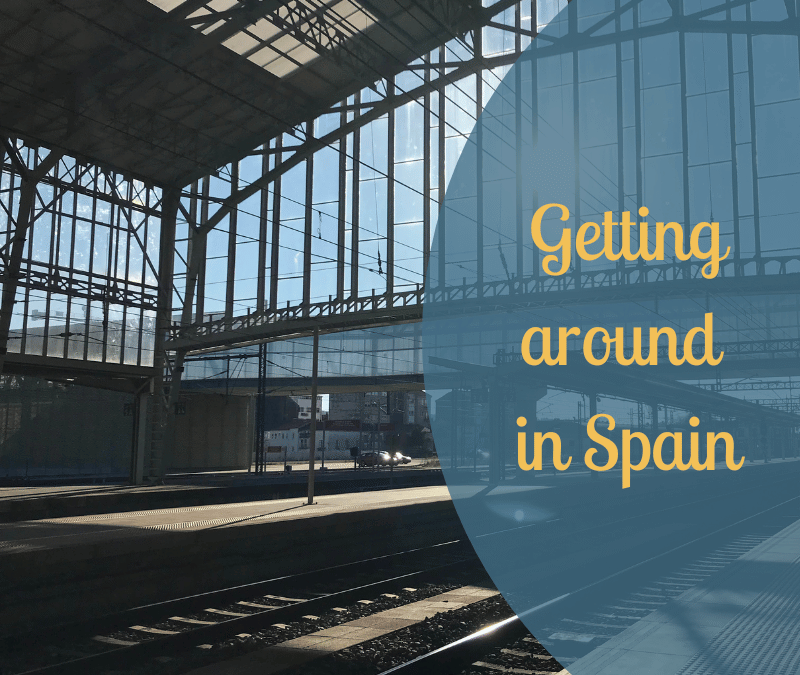
So, let’s go to la estación de tren (you might find it also referred to as estación de ferrocarril, but estación de tren is more common).
- Whether you are travelling by train, bus or plane, your ticket is called billete (by the way, we use the same word for banknotes; 2 meaning, 1 word!)
- If you’re already at the station, you can buy your ticket at the taquilla (ticket office). But be aware that certain trains tend to sell out, so I would advise to buy them in advance. RENFE (Spain’s national train operator) usually releases tickets for same 4-6 weeks in advance, so don’t panic if you’re trying to buy tickets a few months ahead of time and you can’t find them. It’s too early.
- Your billete can be de ida (one way) or de ida y vuelta (return). Before you get on your train, there’s certain information you need to find on your ticket; 2 numbers, to be precise: your car and your asiento (seat). Seats are numbered, so it’s easier to check before you sit down than having to move later on when someone is claiming their seat.
- The information screens at the station will show the vía (track) where your train is stopping.
Discounts for over 60s
If you are travelling by train in Spain and you are over 60, you can get a Tarjeta Dorada (golden card). You can buy it at any train station and it will entitle you to discounts of up to 40% on the price of your tickets.
The Tarjeta Dorada cannot be bought online. You need to buy it in person, as you’ll have to show your passport to prove your age.
The price of the Tarjeta Dorada is €6, and it’s valid for 1 year. It can be renewed online.
Here’s the link to RENFE’s website with all the information about it (it’s in Spanish): http://www.renfe.com/viajeros/tarifas/tarjeta_dorada.html
Travelling by bus
The full name for a bus is autobús, but you can call it bus for short. That’s what most Spanish people do.
The good news is that a lot of the bus-related vocabulary is the same as the train’s, but not all. So let’s have a look at the changes:
- The estación de tren becomes estación de autobuses. However, buses don’t stop at stations only. In fact, there are no stations in most villages and smaller towns. In those cases, buses stop at paradas (de autobús), also known as bus stops in English.
- Tickets are still billetes and they can also be bought from a taquilla. In many cases (local buses in particular), you can buy your ticket directly from the conductor (false friend alert! Conductor is the driver, not the English conductor).
- There are many bus companies in Spain. Some, like Alsa, are big and have even international routes (like between Santiago and Porto). If you’re using one of them, you’ll be able to buy your tickets online in advance. But there are also lots of much smaller, local companies. In those cases, buying your ticket in person, either at the station or from the driver, might be your only option.
Travelling by plane
You are very likely to travel by plane either to get to Spain and start your Camino, and to go back home after you have finished your pilgrimage.
So, what do you need to know about Spanish aeropuertos (airports)? The good news: they are very traveller‑friendly, and all signage is also in English.
- When you land in Spain you will be in the llegadas (arrivals) area of the airport. You should easily find your way out. Just follow the signs for the salida (exit).
- If you are starting your journey from a Spanish airport, you should go to the salidas (departures) area first. You can find both words, salidas and llegadas, in train and bus stations too, on the screens listing all the departures and arrivals.
- If you have luggage to check-in, or need a tarjeta de embarque (boarding pass), look for the the facturación (check-in) counters,
- If you have your boarding pass and equipaje de mano (hand luggage) only, you can go through security and look for your puerta de embarque (boarding gate).
Transport’s Spanish vocabulary
Estación
Tren
Autobús
Avión
Billete
Taquilla
Asiento
Aeropuerto
Equipaje de mano
For accommodation info and Spanish vocabulary, check Where to sleep on the Camino.
Want more?
Make sure you don’t miss any posts or announcements by subscribing for free here. You’ll receive a free Spanish vocabulary guide with your first Spanish words + cultural tips. And… you’ll get access to exclusive content too.

